

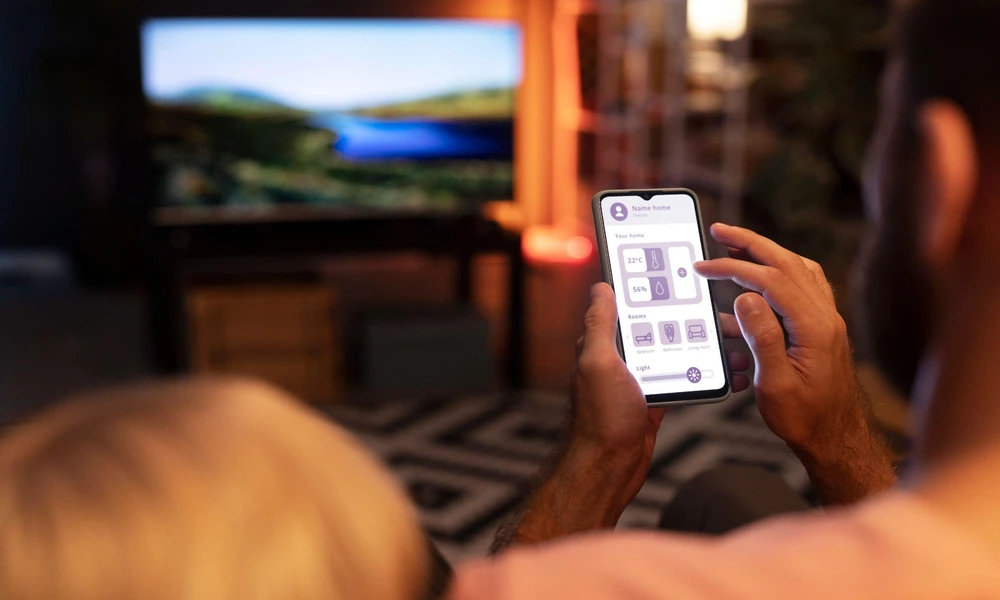
Image Recommendation: A smartphone displaying a home automation app with a curtain schedule set, the actual curtain visible closing in the background.
The single biggest reason households end up happy they motorised their curtains or blinds usually has nothing to do with convenience, even though convenience is almost always the reason they bought the system in the first place.
What a Schedule Actually Does That a Remote Doesn’t
A remote control or an app button still requires someone to remember to use it, at the right time, which in practice means it mostly gets used when someone’s already standing in the room and notices the sun is too bright. A scheduled system acts whether anyone’s home or thinking about it at all, closing a west-facing blind automatically before the afternoon sun hits a room, or opening curtains gradually at a set time each morning rather than all at once. That consistency is where most of the actual benefit of smart curtain systems in Singapore shows up over months, not in any single dramatic moment.
Why the Heat Timing Matters More Than People Expect
Singapore’s intense afternoon sun through an unshaded window doesn’t just create glare; it measurably raises a room’s temperature, which means an air-con unit works harder to compensate for heat that a closed blind could have blocked before it built up. A scheduled system that closes blinds or curtains automatically ahead of the sun’s peak hours, rather than after a room’s already warmed up, tends to reduce how hard cooling systems have to work during the hottest part of the day. It’s a modest effect in any single room, but it adds up across a day, a week, and eventually a utility bill, in a way a single remote-press rarely achieves consistently.
The timing only works, though, if the schedule actually reflects how the sun moves across a specific facade rather than a single blanket setting applied to every window in the home. A west-facing bedroom and an east-facing kitchen are heating up at completely different points in the day, and a system set up without accounting for that tends to close blinds either too early, losing useful daylight for no reason, or too late, after the room has already warmed past the point where closing anything helps much. Getting the schedule right the first time usually means walking through each room’s actual sun exposure rather than copying one setting across the whole home.
What Else a Scheduled or App-Based System Tends to Change
- Mornings: curtains opening gradually at a set time rather than a sudden full reveal, which tends to suit light sleepers better.
- Security: blinds or curtains moving on a schedule while a household is away, rather than staying visibly closed the entire time.
- Accessibility: high or hard-to-reach windows becoming manageable for anyone who’d otherwise need a pole or a chair.
Where Motorised Blinds Fit Into the Same System Differently
Motorised blinds in Singapore homes usually get folded into the same app or hub as motorised curtains, but they tend to get used for a slightly different kind of scheduling: smaller, more frequent adjustments through the day rather than one big open-or-close action. A venetian or roller blind set to tilt gradually as the sun moves, rather than simply opening or closing once, can maintain a more even light level across a whole afternoon with no one touching a switch. That’s a different kind of automation value than a curtain’s blackout-at-night routine, even when both are controlled from the exact same app, which is usually the point of pairing them in one system rather than treating them as separate purchases.
What to Actually Check Before Committing to a System
1. Whether the chosen motors and hub are compatible with an existing smart home setup, or whether a new, separate app is required.
2. Whether a manual override is available for days when the schedule doesn’t match what’s actually needed in the room.
3. How the system behaves during a power outage or Wi-Fi disruption, since a schedule only works while the system itself is online.
The appeal of motorising curtains and blinds tends to start with not wanting to get up and close them. What actually keeps people glad they did it, months later, is usually the quieter stuff: a cooler room in the afternoon, a gentler wake-up, a blind that’s already adjusted before anyone’s thought to ask, and a utility bill that reflects a little less strain on the air-con than before.
Working out which rooms would actually benefit from scheduled automation, rather than just the convenience of a remote, is easiest to map out room by room. Contact De Art Studio to talk through a setup.
