

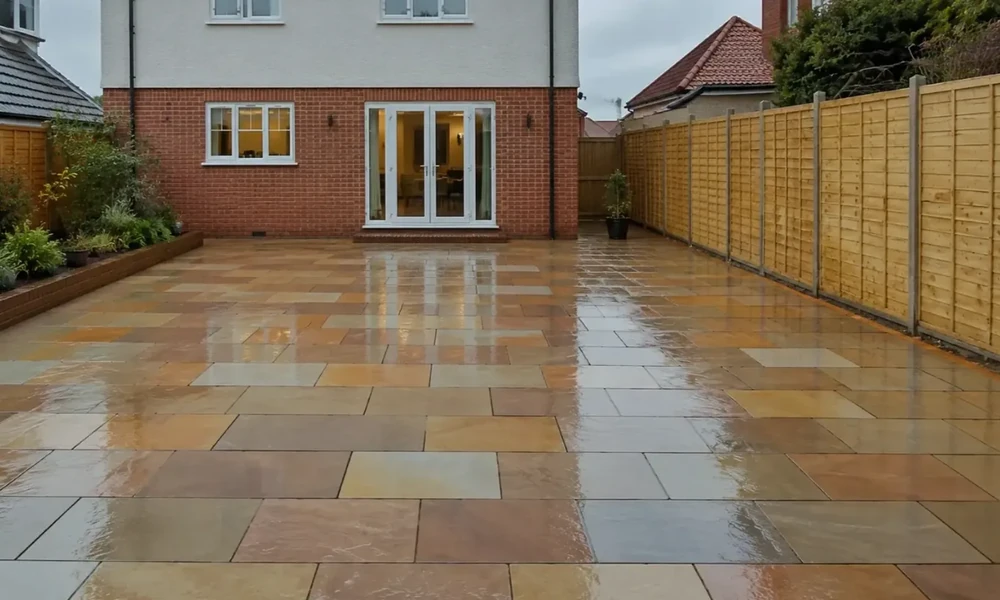
The format of Indian sandstone affects the finished patio almost as much as the colour. Large rectangular slabs create fewer joints and a more directional layout. Square slabs produce a controlled grid, while mixed-size patio packs give a more traditional appearance but require additional setting out.
The correct format depends on the dimensions of the patio, the architecture of the property and the amount of cutting required around walls, drains, inspection covers and steps.
Choose the Stone and the Format Together
Colour should not be selected independently from slab size. A restrained grey sandstone laid in a regular square pattern creates a different result from the same colour laid as a mixed-size patio pack.
The complete Indian sandstone paving collection allows homeowners, landscapers and installers to compare available colours, surface finishes and slab formats before ordering.
How Does Sandstone Colour Affect the Layout?
The same laying pattern can produce a substantially different result depending on the natural colour variation within the stone.
Kandla Grey
Kandla Grey often works well in regular single-size layouts because its silver-grey, mid-grey and occasional blue-grey tones support a cleaner and more restrained appearance.
A structured layout can make Kandla Grey suitable for modern extensions, rendered properties, anthracite doors and contemporary garden designs.
Raj Green
Raj Green contains olive, buff, brown, grey and muted green tones. Its stronger internal variation is particularly compatible with mixed-size layouts and traditional gardens.
The changing slab sizes help distribute the colour movement across the patio rather than concentrating it within repeated rows.
Autumn Brown
Autumn Brown produces a warm and rustic surface containing brown, copper, charcoal and rust tones. It can be laid in a regular single-size pattern, although mixed formats often complement its strong natural variation.
Rippon Buff
Rippon Buff normally contains buff, beige, honey, gold and occasional pink or brown tones. Larger slabs display wider areas of colour, while mixed-size layouts create a more traditional composition.
Fossil Mint
Fossil Mint contains pale cream, beige, soft mint and natural fossil or mineral markings. It can brighten a small or shaded garden, although a simple layout is often preferable because excessive jointing can make a pale patio appear visually busy.
What Are the Main Indian Sandstone Formats?
Indian sandstone is commonly supplied in single-size slabs or as mixed-size patio packs. Each format changes the number of joints, the direction of the layout and the level of installation planning required.
The principal options include:
- Large rectangular slabs
- Regular square slabs
- Mixed-size patio packs
No format is universally better. The correct choice depends on the proportions and geometry of the patio.
What Are the Advantages of Large Rectangular Slabs?
Large rectangular sandstone slabs create a strong directional layout. They are commonly used on medium and large patios where the aim is to reduce the number of joints and create longer visual lines.
Main Advantages
- Fewer joints across the patio
- Efficient coverage of open areas
- Strong directional appearance
- Suitable for running bond layouts
- Compatible with contemporary architecture
- Displays natural mineral markings clearly
Main Limitations
- Heavier handling during installation
- Narrow perimeter cuts are more noticeable
- Requires accurate setting out
- Uneven bedding is more visible
- May require additional cutting around drains and steps
Large slabs work best where the patio is broadly rectangular and the overall dimensions can be coordinated with the selected slab module.
When Should 600 × 600 mm Slabs Be Used?
600 × 600 mm sandstone paving creates a regular square layout. The repeated module gives the patio a controlled and balanced appearance while still allowing the natural colour variation of the sandstone to remain visible.
This format can be suitable for:
- Compact patios
- Square or rectangular seating areas
- Formal courtyard layouts
- Wide garden paths
- Areas centred on a table, fire pit or garden feature
- Properties where a regular grid suits the architecture
Advantages of 600 × 600 mm Sandstone
- Creates a consistent square grid
- Suits balanced and symmetrical patio designs
- Can simplify quantity calculations
- Works with both restrained and strongly varied sandstone colours
- Provides a middle ground between large slabs and small mixed formats
Points to Consider
A square grid makes alignment errors easy to identify. The installer must check whether the house wall and garden boundaries are genuinely square before selecting the starting line.
Where the boundary is out of alignment, following it too closely may cause the joints to appear crooked when viewed from the house. In some gardens, a border or controlled cutting line can provide a cleaner result.
Why Choose a Mixed-Size Patio Pack?
Indian sandstone patio packs normally contain several rectangular and square slab sizes designed to be combined within one patio layout.
They are particularly suitable for:
- Traditional properties
- Cottage gardens
- Courtyards
- Informal seating areas
- Period brick houses
- Gardens containing existing natural stone
- Patios where a less repetitive appearance is preferred
The variation in slab size helps create traditional character, but mixed-size does not mean the slabs can be placed randomly without planning.
Advantages of Patio Packs
- Creates a traditional multi-size layout
- Reduces obvious repetition
- Distributes sandstone colour variation across the patio
- Works well with rustic and period properties
- Can adapt to some irregularly shaped areas
Limitations of Patio Packs
- Requires more setting out than a single-size format
- The installer must monitor the remaining quantity of each slab size
- Incorrect planning can create repetitive joints
- Some patio dimensions may require additional cutting
- The pattern can become visually busy in a very small space
Are Patio Packs Laid in a Fixed Pattern?
Some patio packs are supplied with an indicative module or recommended laying pattern. However, the installer must still adapt the pattern to the actual dimensions of the site.
A successful mixed-size layout should avoid:
- Four corners meeting at one point
- Long uninterrupted joint lines
- Repeated clusters of the same slab size
- Narrow unsupported cuts
- Using all of one size too early
The layout should be reviewed regularly during installation rather than planned only one row at a time.
Which Format Makes a Small Garden Look Larger?
A simple and controlled arrangement normally works best in a small garden. Excessive slab sizes, joint lines and pattern changes can make a limited space appear more fragmented.
Rectangular slabs laid across the narrower dimension can make the patio appear wider. A 600 × 600 mm square grid can also work where the area is compact, balanced and reasonably square.
A mixed-size patio pack may still be suitable, but the pattern should not contain an excessive concentration of small slabs.
Which Format Is Best for a Large Patio?
Large patios can accommodate both single-size and mixed-size layouts.
A regular single-size format usually creates a cleaner and more expansive appearance. It also reduces the total length of jointing across the project.
A mixed-size layout can prevent a large traditional patio from appearing too formal or repetitive, especially where the property has period brickwork, mature planting or existing stone walls.
The size of the patio alone should not determine the choice. The architecture and intended design style remain important.
Which Format Creates the Least Waste?
Single-size slabs normally create the least waste on a rectangular patio designed around the selected module. The installer can calculate the likely number of full slabs and perimeter cuts before work begins.
Waste usually increases where the patio includes:
- Curved edges
- Diagonal laying patterns
- Multiple steps
- Drainage channels
- Inspection covers
- Narrow borders
- Irregular boundary walls
- Fixed posts or garden structures
A patio pack can sometimes provide greater flexibility around irregular features, but it does not automatically eliminate cutting waste.
Which Layout Is Easiest to Install?
A regular square or rectangular single-size layout is generally easier to calculate and monitor than a mixed-size pattern.
However, the practical difficulty also depends on the condition of the sub-base, the accuracy of the patio dimensions and the number of fixed obstacles.
A simple slab format installed badly will still produce an unsatisfactory result. Accurate levels, full mortar contact, consistent joints and suitable drainage falls are more important than pattern complexity alone.
Common Patio Layout Mistakes
Four Corners Meeting
Four slab corners meeting at one point creates a weak and visually awkward junction. It should normally be avoided in both single-size and mixed-size layouts.
Long Continuous Joints
Long straight joints can dominate the patio and make minor alignment errors more noticeable. A running bond or properly planned mixed layout can break up these lines.
Narrow Perimeter Cuts
Tiny strips of sandstone are difficult to support correctly and can look poorly planned. The starting line should be adjusted before installation begins.
Uncontrolled Joint Widths
Natural sandstone requires practical tolerance because slab dimensions and edges may vary slightly. However, the joints should still remain visually balanced and reasonably consistent.
Following an Uneven Wall
A house wall or boundary may not be perfectly straight. Following every deviation can cause the whole patio layout to appear distorted.
Using the Small Patio-Pack Slabs Too Early
Small slabs are often useful for completing pattern transitions. Using too many at the beginning may leave the installer without the correct sizes for later sections.
Failing to Dry-Plan the Layout
The slab pattern should be checked before permanent bedding begins. This is particularly important near doors, steps, drainage channels and inspection covers.
Format Comparison
| Format | Appearance | Best use | Installation difficulty |
|---|---|---|---|
| Large rectangular slabs | Clean and directional | Medium and large patios | Moderate |
| 600 × 600 mm slabs | Regular square grid | Compact patios, paths and formal areas | Moderate |
| Mixed-size patio packs | Traditional and varied | Period properties and informal gardens | Higher |
How Should the Patio Be Set Out?
The installer should begin by measuring the complete area and identifying the principal sight lines from the house, doors and garden entrances.
The proposed layout should then be checked against:
- The overall patio width and length
- The selected joint width
- The position of doors and thresholds
- The location of drains
- The direction of the required fall
- The position of steps and retaining walls
- The likely size of the perimeter cuts
It is often better to distribute cuts across two sides of the patio than to finish with a very narrow strip along one edge.
How Much Extra Stone Is Required?
- Allow approximately 7-10% extra for a simple rectangular patio.
- Allow more for diagonal layouts or extensive cutting.
- Increase the allowance for irregular boundaries and multiple steps.
- Do not order only the measured net area.
- Retain spare matching slabs for future repairs where possible.
The precise allowance depends on the slab format and the complexity of the layout. A detailed cutting plan can reduce unnecessary waste, but natural stone should still be ordered with a sensible contingency.
Should Different Sandstone Sizes Be Mixed?
Different slab sizes should only be mixed where the dimensions work together as part of a controlled pattern.
Adding unrelated sizes without a layout plan can produce inconsistent joints, awkward gaps and unnecessary cutting. Purpose-designed patio packs are generally more practical than combining separate slab sizes at random.
Final Advice
Use a regular single-size format where a cleaner and more structured patio is required. Use 600 × 600 mm slabs where a square grid suits the proportions of the site. Choose mixed-size patio packs where traditional character and a less repetitive layout are the priority.
The correct slab format is the one that fits the patio dimensions without creating narrow cuts, excessive waste or an unnecessarily complicated joint pattern.
Whatever format is selected, the patio should be measured and planned before installation begins. Good setting out, balanced cuts, consistent joint widths and correct drainage will have a greater effect on the finished result than slab size alone.
