

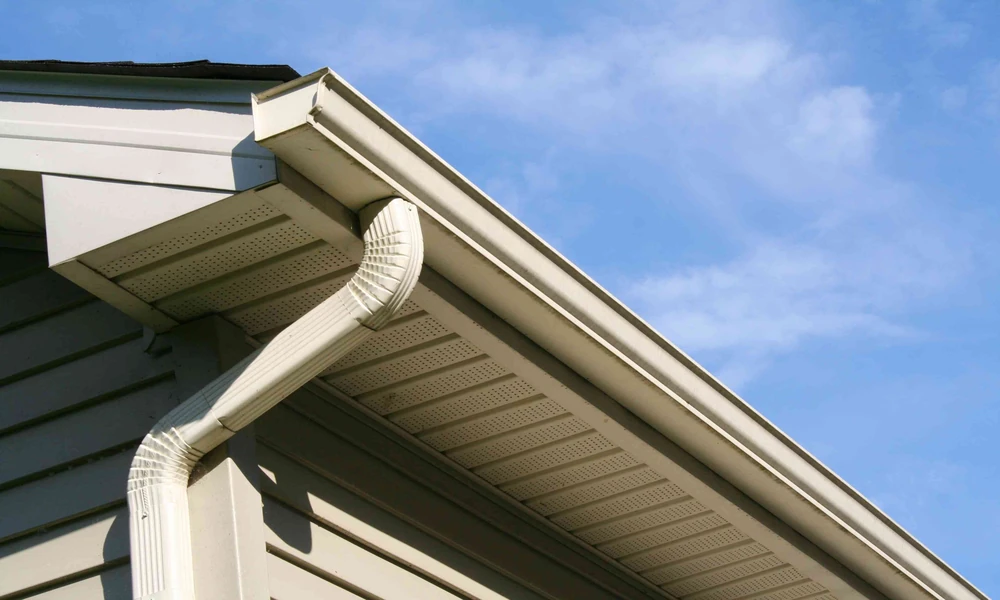
A gutter system is the last stage of a roof’s drainage plan. In southeast Texas it may also be the stage that gets tested hardest. Rain here tends to arrive in short, heavy bursts rather than long drizzles. Tropical moisture from the Gulf can drop several inches in an afternoon, and a gutter that works fine in a light shower can overflow badly in those conditions. When that water spills over the front edge or backs up behind the gutter, it soaks the fascia, stains the siding, and pools near the foundation.
Most gutter failures come from choices made during installation, not from age. Size, spacing, fastening, and the way the gutter meets the roof edge decide whether the system handles a storm or just adds weight to the eaves. The same choices shape how long the lowest courses of shingles and the wood behind them hold up. Seven of them matter most.
Anyone planning Gutter Installation in Montgomery County should have the roofline looked at before anything gets hung, since new gutters fastened to a failing edge only hide the real problem. Cedar Rock Roofing handles that roof side of the job. The team fixes leaks and damaged shingles at the eaves, replaces full roofs, and inspects and documents storm damage for insurance claims. They are veteran-owned, fully insured, and based in Montgomery, and they also serve Conroe and Magnolia. A call or text to (936) 282-5840 sets up a free estimate so the roof and gutters can be planned together rather than one at a time.
1. Sizing the Trough for Local Downpours
Standard residential gutters come in 5-inch and 6-inch widths. The larger size carries roughly 40 percent more water. That difference matters on homes with steep pitches, long uninterrupted slopes, or valleys that funnel runoff from two roof planes into one corner. Metal roofs shed water faster than shingles and push more volume into the gutter at once. As a rough rule, a long run of gutter that relies on a single outlet is a strong candidate for the wider size. Many homes use 5-inch gutters on most edges and 6-inch only where valleys concentrate the flow.
2. Downspout Count, Size, and Discharge
A wide gutter drains no better than its outlets allow. Five-inch systems usually pair with 2×3-inch downspouts. Six-inch systems call for 3×4-inch downspouts, which also pass leaves and pine needles more easily. A common guideline is one downspout for every 30 to 40 feet of gutter, with more added on steep or valley-heavy roofs. Where the water lands matters just as much. Much of Montgomery County sits on clay soils that swell when wet and shrink as they dry. Downspouts that dump right next to the slab speed up that cycle, so extensions or underground drains should carry water at least several feet out from the foundation.
3. Material and Seams
Seamless aluminum, formed on site from a continuous coil, is the most common choice because it gets rid of the joints where sectional gutters tend to leak. Thickness varies. A heavier gauge resists denting from ladders, falling limbs, and hail far better than thin stock. Vinyl costs less, but it can sag and warp in long Texas summers. Steel and copper cost more and last longer, and they suit homes where the gutters are also a design feature. Whatever the material, fewer seams means fewer places for water to escape.
4. Hangers and Slope
Gutters should drop gradually toward each outlet, usually about a quarter inch for every 10 feet. Too little slope leaves standing water that breeds mosquitoes and holds debris. Too much slope looks crooked from the street. Hidden hangers screwed into the fascia hold far better than older spike and ferrule setups, which loosen as the wood expands and contracts. Spacing hangers around every two feet, and closer under tree cover, helps a full gutter carry its weight during a heavy storm without pulling away.
5. The Connection at the Roof Edge
Water clings to surfaces. Without a proper drip edge, runoff can curl under the last row of shingles and run down behind the gutter, rotting the fascia and the decking edge while the gutter itself looks fine. Drip edge flashing should sit over the back of the gutter so water lands inside the trough and not behind it. Any soft or rotted fascia boards need to be replaced before new gutters go up. Hanging fresh aluminum on decayed wood just delays a bigger repair.
6. Guards That Suit the Trees
The pines common across this area shed needles that slip right through coarse screens and form dense mats. Micro-mesh guards stop needles better than wide screens or perforated covers. Reverse-curve hoods work well in some settings but can overshoot in very heavy rain. No guard ends maintenance completely, since fine debris and pollen still build up on top. How a guard attaches also matters. Designs that slide under the first course of shingles can lift them or break their seal, and some shingle makers treat that as a reason to deny warranty claims.
7. Timing Around Roof Work and Storms
The best time to install or replace gutters is usually right after a roof replacement or at the same time. Drip edge is often replaced during a reroof, and gutters taken down for that work rarely go back up as cleanly as new ones. After a hailstorm, gutters and downspouts are often the clearest sign of how large the hailstones were and which direction they came from. Photograph dents on gutters, vent caps, and downspouts before any repairs, because those soft metal marks help show that damage came from a specific storm. Some policies exclude purely cosmetic dents, so it’s worth knowing how your coverage treats gutters before a claim.
Taken together, these choices determine whether a gutter system protects the roof edge or quietly works against it. Getting size, outlets, fastening, and flashing right at the start costs far less than repairing fascia, siding, and foundation damage later.
