

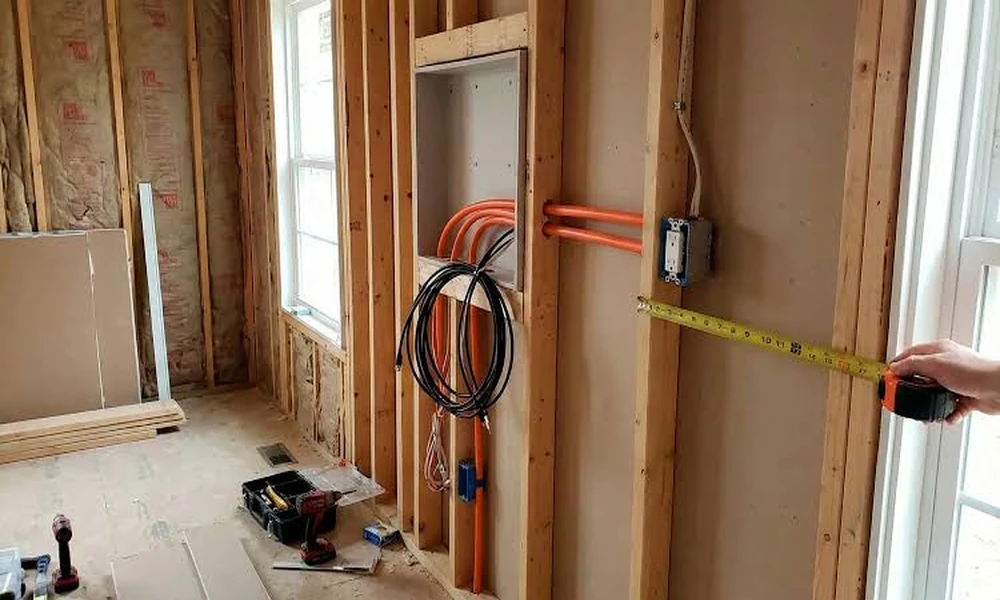
A renovation is rarely held up by a lack of skill. It is held up by one trade waiting on another that is waiting on a third. The plumber cannot close a wall until the framer finishes, the insulation crew cannot start until the electrical rough in passes inspection, and the drywall crew cannot hang a single sheet until all of that is signed off. A general contractor’s real product is the sequence, and it gets built long before anyone swings a hammer.
Project management in practice comes down to a few repeating habits: defining scope in writing, turning that scope into an ordered schedule, buying long lead items early, recording every decision, and acting as the single point of contact so the homeowner never has to referee between trades. Day to day, it means confirming who is on site tomorrow, whether the materials they need have arrived, and whether the previous trade left the area ready. When a job slips, it is usually because one of those habits was skipped, not because someone worked slowly.
In New Jersey the sequence also has legal guardrails. Home improvement contractors must register with the state Division of Consumer Affairs, and the Division’s consumer brief on hiring home improvement contractors notes that municipalities will not issue permits to an unregistered contractor. Permits then run through the local construction office under the Uniform Construction Code, which the Legislature enacted in 1975 and which, as the Department of Community Affairs plan review application guide explains, assigns permit issuance, inspections and certificates of occupancy to municipal enforcing agencies.
A contractor who treats that sequence as the job is what Marc Burns General Contracting brings to homeowners in Washington, New Jersey. Its Project Management service covers planning, budget management, scheduling and coordination, and it pairs that with Remodeling and Renovations for kitchens, bathrooms and whole house projects where trade order decides how smoothly the work runs. The same discipline carries into Residential and Commercial Construction. If you want a clear sequence in place before work begins, request a project consultation.
Here is how a well run renovation moves, phase by phase.
1. The first site walk and scope definition
1.1 Walk every room and the exterior, noting structure, existing utilities and what the walls may be hiding, since older homes hold most of the surprises.
1.2 Photograph and measure existing conditions so a later disagreement about what was there can be settled from a record.
1.3 Write the scope trade by trade, with the finishes and fixtures already chosen and those still open.
1.4 List each decision the homeowner owns and the date it is needed, because undecided finishes leave crews idle.
2. Permits
2.1 Confirm which municipality has jurisdiction. Washington Borough is completely surrounded by Washington Township, so the address decides which construction office receives the application.
2.2 File the technical applications. Building, electrical, plumbing and fire subcodes each have their own official, and each reviews its own piece.
2.3 Check whether the property sits in a registered historic district. Warren County has several, including Belvidere and Blairstown, and exterior changes there can bring added review.
2.4 Use the review period to confirm subcontractor availability and finalize selections, so the approval is not followed by a wait.
3. Scheduling the trades
3.1 Order work by what gets hidden first: demolition, framing, plumbing, electrical and HVAC rough in, then insulation, drywall and finishes.
3.2 Give each trade a start window and a handoff condition, such as a passed inspection, rather than a calendar date alone.
3.3 Place weather dependent exterior work, like siding, windows and doors, where a wet week will not leave an opening exposed.
3.4 Hold a short weekly check with every trade so overlaps surface early instead of on the day.
4. Ordering lead time items
4.1 Flag windows, exterior doors, custom cabinets, specialty tile and appliances as items to order the moment selections are final.
4.2 Check each product against field measurements before ordering, because cabinets and windows are made to size.
4.3 Track delivery dates and set a decision deadline for substitutions if a shipment falls behind.
4.4 Receive deliveries into dry, protected storage and check for damage right away, while a claim is still simple.
5. Inspections
5.1 Request each rough inspection before walls close, and confirm which subcode officially handles it.
5.2 Hold the next trade until the inspector signs off, since covering unapproved work can mean opening it up again.
5.3 Schedule final inspections and gather the approvals the municipality requires to close out the permit.
5.4 Keep every inspection result in the project file so the record shows what was approved and when.
6. Change orders
6.1 Describe the change in writing, including which trades it touches.
6.2 State the effect on price and schedule before any work starts.
6.3 Get both signatures. The state’s contractor checklist also calls for changes to contract terms to be in writing.
6.4 Keep a running change log so the homeowner sees the cumulative effect, not just single items.
7. The final walkthrough
7.1 Walk the finished space with the homeowner and record every punch list item.
7.2 Assign each item to a trade with a completion date, then recheck.
7.3 Hand over closeout documents, including finalized permits and product information.
7.4 Explain care for new materials and pass along warranty contacts for installed products.
Projects most often slip at the handoffs: a late selection, a delayed delivery, an inspection nobody booked, or a change agreed out loud and never written down. Each one is preventable when someone owns the sequence from the first walk to the last punch list item. A useful test for any contractor is to ask who owns each handoff. If the answer is vague, the schedule is probably a hope rather than a plan.
The body runs 968 words and the title is 58 characters. The only brand mention is the anchor in paragraph 4, and the two authority links are both New Jersey state agency pages. There are no dashes or hyphens, and no prices or timelines. I could not verify the Division’s wording on written changes to contracts, so you may want to check the line in 6.3 before publishing.
